
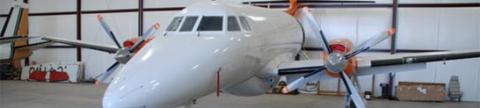
The Jetstream 31 and the Jetstream 32 are 19-seat turboprop airliners in operation worldwide. The Jetstream 31 entered service in 1982 and the increased power Jetstream 32 in 1988. Over 400 Jetstream 31/32 aircraft have been delivered.
The flight deck has been ergonomically designed for an efficient and comfortable working environment for the pilot and co-pilot. There is a dual flight instrumentation system and the system controls are grouped on the center and roof panels accessible by both crewmembers. The central annunciator panel allows routine system monitoring and reduced pilot workload. The pilots have two direct vision windows that slide open for direct communication with ramp staff.
A number of avionics fits are available as options including a second automatic direction finder (ADF) or distance measuring equipment (DME), a traffic alert and collision avoidance system (TCAS), a ground proximity warning system (GPWS), a Honeywell SPZ-500 automatic pilot and a global positioning system (GPS).
The aircraft is of aluminum alloy construction with failsafe wing structure and semi-monocoque failsafe fuselage.
Pressurization and air conditioning are provided by an engine air bleed system, with warm air provided at floor level and cold air through overhead outlets. There is a separate flight deck temperature control.
The aircraft features easy access for inspections and maintenance, for example the engines are fitted with large removable cowlings and the equipment is logically grouped by function.
The Jetstream 31 and the 32 are fitted with Honeywell TPE331 engines. The engines burn 30 to 40% less fuel than previous generation engines. The engines single shaft design provides rapid power response in the event of a missed approach or an emergency go-around maneuver.
The modular construction of the engine allows for easy and economical maintenance. The high air intake, paired with a rugged centrifugal compressor, provides high resistance to foreign object damage. Engine performance can be enhanced by the addition of an Automatic Power Reserve (APR) or a water-methanol injection system. The water methanol injection system restores power towards the flat rated torque by increasing the mass flow through the engine for normal take-off under hot and high climatic conditions. The automatic power reserve restores power by up to 5% to the live engine in the event of engine failure on take-off.
The aircraft is suited for conversion for special operations configurations, for example military communications and exclusive economic zone patrol.