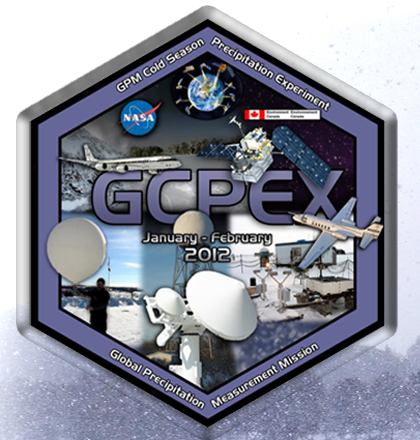
The Global Precipitation Measurement Cold-season Precipitation Experiment (GCPEx) will measure light rain and snow in Ontario, Canada in January and February. NASA will fly an airborne science laboratory above Canadian snowstorms to tackle a difficult challenge facing the upcoming Global Precipitation Measurement (GPM) satellite mission -- measuring snowfall from space. GPM is an international satellite mission that will set a new standard for precipitation measurements from space, providing next-generation observations of worldwide rain and snow every three hours.
Read more: http://www.nasa.gov/topics/earth/features/winter-dc8.html
Falling snow is critically important for society in terms of freshwater resources, atmospheric water and energy cycles, and ecosystems. The GCPEx mission uses instrumented aircraft (NASA DC-8, NASA-funded University of North Dakota Cessna Citation, and Canadian National Research Council Convair 580) for flights over heavily-instrumented ground sites located in and around the Environment Centre for Atmospheric Research Experiments (CARE) located in Egbert, Ontario.