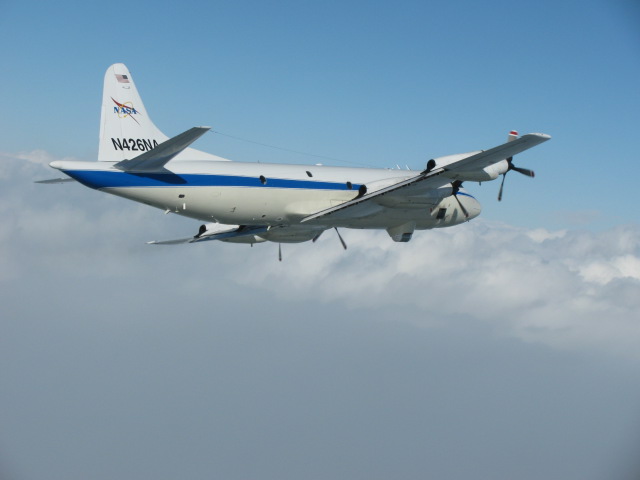
Forest ecosystems play an important role in the global carbon cycle by sequestering carbon dioxide from the atmosphere but also releasing carbon to the atmosphere upon decomposition. Currently, land imagers are able to provide important information on forest cover, extent, and condition, but knowing the 3-dimensional structure of vegetation is important for quantifying the amount of carbon stored in biomass. In an effort to develop new instruments for determining biomass structure, and to pave the way for future satellites such as DESDynI, the NASA P-3 is currently flying the ECO-3D mission over Maine, New Hampshire, Pennsylvania and Florida.
The primary payload, DBSAR, collects Polarimetric and Interferometric SAR data to validate biomass estimates in order to advance our understanding of the carbon cycle. DBSAR will also help advance the use of SAR for ecosystems while informing scientists about the potential of digital beam forming technology to map tree heights, forest biomass, and land cover type.
As part of the August campaign, NASA will also fly two other instruments, the Slope Imaging Multi-polarization Photon-counting Lidar (SIMPL), and the Cloud Aerosol Radiometer (CAR). SIMPL is a multi-beam, micropulse, single photon ranging laser altimeter (Fig. 2) that will provide measurements of forest canopy structure with very high spatial resolution (Fig. 2) and two-color polarimetry data that can be used to differentiate stand types. CAR is an airborne multi-wavelength scanning radiometer that can measure spectral directional reflectance over uniform forests, homogenous clouds, and bright targets. During this deployment, CAR will be employed to derive the Bidirectional Reflectance Distribution Function (BRDF) and the vegetation clumping Index.
Data collected with these instruments will be used to advance the development of algorithms for biomass estimation, and in particular, the lidar-radar fusion techniques to estimate biomass and vegetation structure. Of special interest, DBSAR’s InSAR phase coherence measurement of microwave scattering dispersion in forest canopies will be compared to the SIMPL canopy height and structure results. This assessment will be in preparation for the DESDynI mission, to ascertain if L-band phase coherence can be calibrated by lidar data to yield reliable mapping of vegetation height and thereby estimation of aboveground biomass.