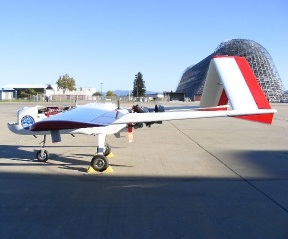
The Sensor Integrated Environmental Remote Research Aircraft (SIERRA) is a medium-class, unmanned aircraft system (UAS) that can perform remote sensing and atmospheric sampling missions in isolated and often inaccessible regions, such as over mountain ranges, the open ocean, or the Arctic/Antarctic. UAS missions are of particular value when long flight durations or range-measurement requirements preclude a human pilot or where remote or harsh conditions place pilots and high-value aircraft at risk. Designed by the U.S. Naval Research Laboratory and developed at NASA's Ames Research Center, the SIERRA is well suited for precise and accurate data collection missions because it is large enough to carry up to 100 pounds of scientific instruments for up to 600 miles yet small enough not to require a large runway or hangar.
The NASA SIERRA project is supporting USGS Principal Investigator Jonathan Glen on a NASA funded experiment to demonstrate the use of Unmanned Aircraft for mapping buried geologic faults and providing information on aquifers. The SIERRA is flying low and slow in order to enable measurements by a flux-gate magnetometer mounted on the left wing tip. Flights are taking place in September in Surprise Valley, California.